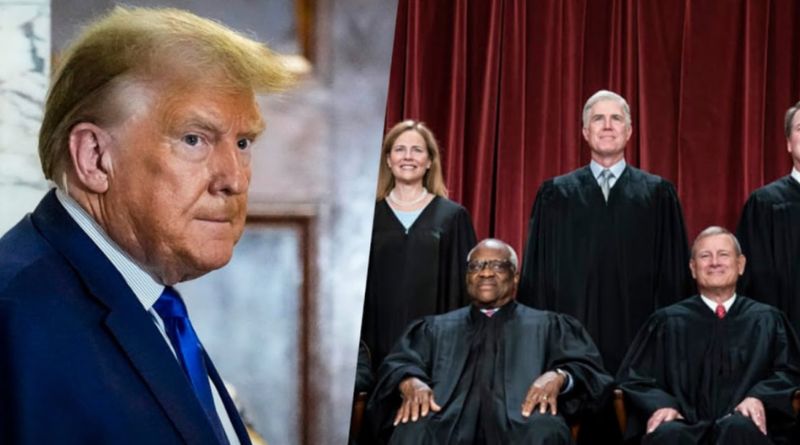
President Donald Trump secured a major legal victory at the U.S. Supreme Court after the justices ruled in favor of his administration’s effort to end protected legal status for hundreds of thousands of migrants living in the United States.
In an 8–1 decision, the Supreme Court lifted a lower court injunction that had blocked the administration from moving forward with plans to terminate Temporary Protected Status (TPS) protections for approximately 300,000 Venezuelan migrants. Justice Ketanji Brown Jackson was the lone dissenter.
The ruling allows the administration to proceed with ending protections created under the Biden administration and could open the door for the removal of affected migrants. Administration attorneys argued that immigration decisions involving TPS fall under executive authority and should not be limited by lower courts.
U.S. Solicitor General John Sauer criticized the lower court’s intervention, arguing that immigration decisions involve “discretionary, sensitive, and foreign-policy-laden judgments” that belong to the executive branch.
The legal dispute centers on a February memorandum issued by Department of Homeland Security Secretary Kristi Noem, which revoked TPS protections established for Venezuelans in 2023. The memo stated that after reviewing conditions in Venezuela, DHS concluded that the country no longer met the requirements necessary to justify continued TPS designation.
TPS protections for Venezuelans have changed several times in recent years. The first designation came in 2021 under then-DHS Secretary Alejandro Mayorkas, who cited extraordinary conditions in Venezuela. Extensions and redesignations followed in 2022, 2023, and early 2025 before Noem reversed the latest extension and restored previous policies.
Earlier this year, U.S. District Judge Edward Chen blocked Noem’s action, arguing that descriptions portraying migrants as potential criminals lacked evidence and raised concerns about bias.
In a separate immigration-related case, the Supreme Court declined to revive Florida’s SB 4-C law, which would have allowed state officials to prosecute migrants who entered Florida illegally after unlawfully entering the United States. Lower courts previously blocked the law, citing concerns that federal immigration authority preempts state action.